
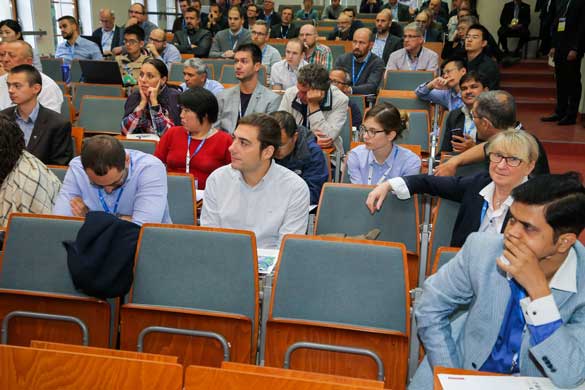
ICESP XIV – Wroclaw, Poland, 2016
The International Conference on Electrostatic Precipitation (ICESP) is the official conference of the International Society for Electrostatic Precipitation (ISESP). The following is a list of papers from the XIV ICESP Conference under their respective topic. Click on the papers title to view the complete paper in PDF format.
19 September 2016 (Day 1)
ESP School
ESP fundamentals–definitions, input parameters, reference conditions, chemistry
ESP design and industrial application: part 1; part 2; part 3
ESP energization and electrical operation
Contemporary challenges to ESP operation and maintenance. A study of selected cases
20 September 2016 (Day 2)
ESP School
Mercury removal in electrostatic precipitators
EHD phenomena in electrostatic precipitators
ESP operation and troubleshooting
21 September 2016 (Day 3)
Technical Sessions
Session 1: Fundamentals I
This work presents the instantaneous flow images and instantaneous velocity vector fields (obtained by PIV measurements) showing the temporal and spatial evolution of the electrohydrodynamic (EHD) two-phase fluid flow after the negative corona inception in the needle-to-plate electrode arrangement. The measurements were carried out in the initially motionless two-phase fluid (mixture of air and incense smoke particles) closed in the discharge chamber. The corona was supplied by the negative high voltage pulses rising linearly on the needle electrode to a certain value and then staying constant. The results showed that the evolvement of the initially motionless EHD two-phase fluid flow in the closed chamber can be divided into four transient structural stages, i.e. the two-phase free jet stage, the initial stage of two-phase wall-impinging jet, the development stage of two- phase wall-impinging jet and the fully developed two-phase EHD jet, and one final single-phase steady-state stage. The results also confirmed the existence in the two-phase free jet stage the series of the mushroom-like flow structures simultaneously travelling from the needle electrode towards the plate electrode, which has been recorded for the first time in [12].
In this paper, the interaction between nanosecond pulsed dielectric barrier discharge and submicron particles is investigated experimentally using particle image velocimetry technique in a wire-to-plane electrostatic precipitator. The induced electrohydrodynamic phenomena have been studied by using time- resolved measurements for both positive and negative polarities of the nanosecond pulsed high voltage. The main results indicate that the velocity of particles is considerably affected by the negative discharges related to the negative transition of the voltage pulse, whatever the polarity. This is probably due to the contribution of the electric wind that could affect both the trajectories of charged and uncharged particles.
For further development of ESPs.
Session 2: HV power supplies I
Emission reduction with three phase technology.
Worldwide the environmental laws and directives require lower and lower limit values for the emission of particles carried by waste gas, e.g. by power plants. The electrostatic precipitators of existing power plants have been constructed years ago to meet certain dust emission limits. Due to the reduction of the limit values that dedusting systems are no longer operating sufficient with reference to the new requirements.
The construction of the electrostatic precipitators was based on certain capabilities of the high voltage system which were standard in the time of the construction. With a new, improved high voltage power supply system it is possible to improve the precipitation rate of an electrostatic precipitator and meet the new, more strictly dust emission limit values. Compared with the investment costs for new fields in the electrostatic precipitator or even replacement of the ESP by baghouse filter or hybrid solutions, the investment for a new high voltage supply system is small. Hence the upgrade of an electrostatic precipitator with sufficient three phase technology to improve the dedusting behavior to a satisfying limit is a sensible measure to be processed.
Besides the improvement of the dedusting behavior of the electrostatic precipitator, even the EMC emission rate could be reduced by changing from single phase to three phase technology.
GE Power environmental products, systems and services today. – Paper Unavailable
Session 3: Hybrid ESPs and fabric filters
One of the most serious problems nowadays is the environmental pollution. In air pollution some important measures have been established since decades, and the emission of some dusts and gases can be stopped by precipitators, such as cyclone, electrostatic precipitator, and others. Unfortunately the emission of airborne dusts causes environmental and health problems worldwide, therefore, to remove them is still an important issue. It is well known, that cyclones can remove dust successfully if the sizes of the particles are above 20-30 μm. The removal efficiency is greater if the gas speed is higher (up to a certain limit around 20 m/sec). The electrostatic precipitators are working satisfactorily if the average particle diameter is above 5-20 μm. The removal efficiency is decreasing by increasing gas speed. The optimal value is below 2 m/sec (rather 1 m/sec).
At the first extent the combination of the cyclone and the electrostatic precipitator seems to be senseless, but if we consider that the motion of the gas and the particle moving with that, in the tube of the outlet is still circular, and the gas will rotate around the internal perimeter of this tube more than 5-10 times, then we can realize that the particles move along this surface a long way providing enough time to the particle to be precipitated. Considering those facts, we built a cylindrical electrostatic precipitator into the outlet tube in order to remove airborne dust (d < 10 μm) from flue gases. Having a built in electrostatic precipitator in a cyclone, it is easy to use pulse energization for decomposition of NOx content of the flue gas introduced into the cyclone.
One of the new technologies is to produce SiC from industrial waste. The SiC is produced using plasma technology, and the end product of this step is powder with the diameter range of 10-70 μm in argon carrier gas. An electrostatic cyclone was constructed, built and applied successfully to collect these powders.
Research on technical route of flue gas ultra-low emission for coal-fired power plant.
To meet the requirement of flue gas ultra-low emission in Chinese coal-fired power plants, Two different technical routes basing on low-low temperature ESP technology and WESP technology are utilized. This paper investigated the cooperative removal effect on other pollutants when denitration, dust removal and desulphurization equipments respectively treating NOx, dust and SO2. Basing on the research, co-governance technical route which meets the demand of flue gas ultra-low emission in coal-fired power plants was put forward. About the technical route of ultra-low emission, a brief analysis on the main function of key equipment, simultaneous removal effect to pollutants, applicable condition, engineering application and so on was made, and some noteworthy problems and suggestions are provided. This paper could provide some references for flue gas treatment in coal-fired power plant.
Fabric filter solutions with very long bags for power plants and industrial applications.
22 September 2016 (Day 4)
Session 4: Fundamentals II
Adaptation aspects of an existing electrostatic precipitators for operation in a new conditions.
Electrostatic Precipitators (ESPs) are commonly used for the efficient removal of solid particles from aerosols in different industrial applications and operating conditions. The applied ESP mechanical configuration depends on the aerosol quality and the collected dust characteristic at operating temperatures. The ESP’s design restrictions and recommendations for successful operation with required particulate removal efficiency are different for hard coal fired boilers compared to biomass fired boilers or chemical boilers. Nowadays there are a number of existing boiler installations rebuilt for operation in new conditions with mixed fuels, greater variation in gas flows, its chemical composition, differentiation in operating temperatures and dust quality. Observed effects of some chemical reactions in the collected dust layer increase the complexity of the dust removal process in the new conditions. In this paper some ESP configuration and adaptation aspects are discussed for new operating conditions.
Mercury removal in semi-dry flue gas desulphurization installations equipped with bag filters.
In this paper, a new electrostatic precipitator (ESP) with asymmetrical wire-to-cylinder configuration is investigated experimentally. The main objective is to evaluate the collection efficiency of high resistivity particles such as the ones released from cement manufacturing processes. The experiments are performed with cement particles ranging from 0.18 to 5 μm with a mean size of about 0.4 μm. An aerosol spectrometer is employed for characterizing the size distribution of these particles at the outlet of the ESP. The collection efficiency is estimated for various DC applied voltage magnitudes and for both positive and negative polarities. The electrical measurements show that the behavior of corona discharges is similar to that obtained in symmetrical wire-to-cylinder configuration. Results show that the particle collection efficiency of the ESP can reach 95% in the case of negative corona discharge.
Relation between gas velocity profile and apparent migration velocity in electrostatic precipitators
Abstract The impact of the gas velocity profile on the collection efficiency for electrostatic precipitators is considered from a theoretical point of view. If non-ideal effects such as rapping, re-entrainment and gas sneakage are neglected, the maximum collection efficiency is obtained with a perfectly uniform velocity profile throughout the precipitator. Employing a linearization of the exponential function in the equation for collection efficiency, a closed form analytical expression for the impact of non-uniform gas flow is derived. In the expression, the square of the coefficient of variation of the gas flow profile enters as a correction factor to the migration velocity. The analytical expression corresponds rather well to exact calculations on actual gas velocity distributions, up to coefficient of variations around 30%. Moreover, it is demonstrated that the same type of approach can be used to derive similar correction factors also when other variables deviate from uniformity.
Session 5: Wet ESPs
Application of wet electrostatic precipitator in 1000 MW coal-fired power plant.
This paper described the principles and characteristics of wet electrostatic precipitator (WESP), and focused on the application of WESP in 1000 MW coal-fired power plant in China. Some important parameters, for example the polar distribution pattern, the homopolar distance and the spray arrangement have been centered on during the design and operation of WESP. In view of the actual situation of Shanghai Caojing 1000 MW coal-fired power plant, optimal selection design was carried out in order to achieve the goal of ultra-low emission. After WESP was put into operation in Shanghai Caojing 1000 MW coal-fired power plant, the actual polluting dust emission can reach 1.45 mg/m3, which is much lower than the emission standard of China [1]. This successful application in 1000 MW coal-fired power plant can provide a useful reference for other reforming engineerings of the large coal-fired power plants.
Continuous measurement/analysis of plastic WESP operating currents.
Wet Electrostatic Precipitators (WESPs) with collecting electrodes made of plastic are commonly used in industrial and chemical processes. Plastic tubes are resistant against many chemical reagents like sulfuric acid, they are very cost efficient and have a comparable low weight. Unfortunately, they are not very robust against thermal stress, which can be caused by locally concentrated and frequent flashovers. The arcs can cause severe and non-reversible damage in the material of the plastic tubes, therefore, the local flashover distribution needs to be controlled by means of the high voltage power supply. The paper shows a method to detect and analyse the flashover location by measuring and comparing the operating currents of the collection electrode sections of the entire precipitator. Furthermore, the WESP discharges (spark, flashover) cause high frequency current and voltage peaks in the collecting electrode grounding system which can result in disconnection of individual collecting electrodes from ground or in a faulty connection to the outer grounding system. Missing ground connections may result in deteriorated ESP performance and increased risk for damages of the collecting electrodes. Single or several faulty ground connections cannot be detected with the usual measurement of the total DC current and voltage at the transformer rectifier set (TR set).
With additional DC current sensors positioned on the ground cables in between the WESP sections lead outs and the outer WESP grounding system, the currents of the ground connections can be monitored in relation to the total DC operating current. In addition the location of the ESP discharges can be estimated and monitored by analysing the wave shape of each DC current measurement. This enables condition monitoring and providing a warning signal due to faulty ground connections, of unbalanced DC current distribution or frequent ESP discharges at a certain position. With corresponding maintenance measures taken in time, possible damage or excessive deterioration of the ESP collecting tubes can be avoided.
Wet ESP technology and its application in coal-fired power plant.
Session 6: Coal, biomass and fly ash
Fly ash resistivity with injected reagents and predicted impacts on electrostatic precipitators.
Wet ESP technology and its application in coal-fired power plant.
Smal l size precipitator for domestic biomass-furnaces.
Domestic biomass furnaces are carbon neutral but are causing considerable amounts of particulate emissions. Electrostatic precipitators are known from industrial applications to clean combustion gases very efficiently. A prototype of a small size precipitator has been developed and tested on a commercial 30 kW wood chip boiler. After some considerations about collecting efficiency and mechanical construction, the main focus was on the design of the high voltage power supply, which has been be realized as a resonant converter in order to increase power efficiency and reduce voltage stress on the switching semiconductor devices. To ensure stable operation, a fast control algorithm was developed to react on electric breakdowns and accurately control the precipitator operation.
Session 7: Submicron particle collection and mercury separation
Co-benefit of catalytic denitrification for reduction of mercury emissions.
Coupled trace gas adsorption mechanisms within ESPs: promotion and inhibition of mercury removal.
Update on in-mill mineral removal to reduce furnace emissions and operating costs.
A novel technology of the simultaneous NOx and SOx removal from the exhaust gas in a glass manufacturing system is developed using a nonthermal plasma-chemical hybrid process (PCHP). Pilot-scale experiments are conducted in a wet-type and a semi-dry type de-SOx reactors of the glass melting plants. The flow rate of exhaust gas is in the range of 6550–17250 m3N/h for the both experiments. NOx and SOx emissions at the furnace outlet range 158–289 ppm and 122–249 ppm, respectively. Ozone generated by ozonizers is injected into the exhaust gas area cooled with water to below 150°C at the de-SOx reactor inlet or the reactor inside in order to oxidize NO to NO2. Almost all of the SO2 is absorbed by a NaOH absorbent resulting in the generation of Na2SO3. Furthermore, reduction of the water-soluble NO2 by Na2SO3 to N2 affords Na2SO4, which can be reused as glass material. The averaged (highest) de-NOx and de-SOx efficiencies are 28 (39)% and 99%, respectively in a wet-type de-SOx reactor. It is expected that the de-NOx efficiency increases in accordance with the increase of de-NO efficiency if the more amount of ozone is injected. This simultaneous de-NOx and de-SOx technology by PCHP is highly practical and promising for exhaust gas aftertreatment in a glass manufacturing system.
Session 8: Submicron particle collection and separation
Modern electrostatic precipitators: getting a second wind. – Paper Unavailable
This paper reviews our recent experiences for upgrading electrostatic precipitators (ESPs) for both reducing emission and saving energy. Since 2013,we have upgraded 16 electrostatic precipitators (ESPs) for 2×135 MW, 2×145 MW, 4×330 MW, 4×600 MW, 2×660 MW and 2×1050 MW coal-fired boilers. Moreover, we performed their full scale demonstrations of PM2.5 and PM10 (particles with diamaters of less than 2.5 μm and 10 μm) emission control with the support of the Chinese 863 program. Both cold-side and colder-side ESPs are evaluated according to their size, electrode, rapping, high-voltage power source, energy consumption, ash inlet load, coal property, PM2.5 and PM10 emission, respectively. Systematic design of both ESPs and flue gas desulfurizaation (FGD) not only benefits SO2 but also PM10 and PM2.5 emission control. For coal-fired boliers, PM2.5 and PM10 concentrations at the ESP outlet are usually below 2.5 mg/m3 and 20 mg/m3, respectively. Their concentrations at the FGD outlet are usually below below 2.5 mg/m3 and 5mg/m3, respectively. For colderside ESPs with a specific collection area of not less than 100 m2/m3/s, the PM10 and PM2.5 concentrations can be controlled to be below 10 mg/m3 and 1.0 mg/m3, respectively. In comparison with traditional ESP at 120- 140 ºC energized by single-phase transformer reactifers (T/Rs), PM10 and PM2.5 emission are usually reduced by a factor of 10 by using three-phase T/Rs.
Submicron particles emission control by electrostatic agglomeration.
An alternating electric field charger/agglomerator, in which particle charging and their coagulation occurs in one stage, is presented in this paper. The charger/agglomerator is based on an alternating electric field charger formed by a set of two discharge electrodes separated by a set of two parallel grids by each side of the discharge electrodes. The particles are charged by ionic current in alternating electric field that allows the charge imparted to the particles to be higher than for DC chargers. Due to oscillatory motion of the particles between the electrodes, particles of different mobilities can collide and coagulate. Number fractional collection efficiency of PM2.5 particles in semi-industrial scale, two-stage charger/agglomerator with precipitator section was higher than 90%.
Application of a pressurized electrostatic precipitator for control of submicrometer particles.
This study was focused on examining the effect of high pressure on the performance of a wire-cylinder electrostatic precipitator (ESP). To investigate ionization process in pressurized ESP, the relationship between current (I) and voltage (V) was characterized using air as the feed gas under different gas pressures. High pressure was experimentally proven to suppress corona inception. Removal efficiencies of NaCl particles and fly ash particles over a submicrometer size range were measured under different gas pressures. It is concluded that current can be lower as a result of higher pressure under similar voltages and remarkably impairs the ESP performance, while voltage tends to be higher as pressure rises under controlled current. How the pressure affects the removal efficiency is also greatly dependent on charging status of the inflow particles.
Session 9: ESP related means of air pollution control
Modern solutions for flue gas cleaning systems – AFAKO’s experience . – Paper Unavailable
Hybrid filtration of sinter plant process fumes.
Ultra-clean electrostatic-fabric integrated precipitator technology realizes ultra-low emission .
In recent years, the ultra-low emission policies have been issued and the dust emission has been required to be below 5 mg/Nm3 by some local governments and electric power groups, which has made dust removal technology be improved. This paper introduces the coal-fired unit of Zhuhai 700 MW Power Plant realizing ultra-low emission of below 5 mg/m3 successfully after it adopted the ultra-clean Electrostatic-Fabric Integrated Precipitator (EFIP) technology. The advantages of ultra-clean EFIP technology in achieving the ultralow emission policy were discussed.
SO 2 removal in pulse energized electrostatic precipitator with heat exchanger for marine diesel.
23 September 2016 (Day 5)
Session 10: Numerical
modelling and computer simulation
Numerical simulation of the airflow distribution of WESP.
The article describes the airflow distribution numerical simulation process of wet electric precipitator (WEPS). The numerical simulation used the SIMPLE algorithm and turbulence model as the model. The monitoring section of the airflow distribution is set at the 100mm distance from the top plane of the anode tube bundle. It can analyzed the internal air flowing condition. By means of the reasonable arrangement of guide plate and the circular hole rate of distribution plate, the airflow distribution on the monitoring section meet the requirements. The results of numerical simulation can provide suggestions for the design of WESP.
Low-low temperature ESPs are important flue gas control device in the near future to achieve ultra-low emission from coal-fired power plant in China. In order to reveal the dust removal mechanism and performance affecting factors of ESP, Fujian Longking Co., Ltd. has carried out considerable research work, including experimental tests under laboratory and engineering conditions, and numerical modelling of LLTESP. In the experimental study of LLTESP, the effect of temperature on the dust resistivity, grade removal efficiency and charge quantity under laboratory and engineering conditions are described in detail. The test results indicate that, as the flue gas temperature is reduced, dust resistivity decreases, grading dust removal efficiency and charging quantity are promoted, enhancing significantly the dust removal efficiency of ESP in engineering applications. In the numerical part, the history of numerical simulation of electrostatic precipitators, technical progress and existing problems are reviewed. The main methods of numerical simulations and the progress of current work are described in details, and the numerical modelling results are analysed. Studies have shown that LLTESP has a significant effect on improving ESP through reduced dust resistivity and increased working voltage. Sulfuric acid condensation can increase the particle saturation charge by an increase in effective dielectric constant of dust particles. The decrease of flue gas temperature changes air density, viscosity, dust resistivity, electric field and acid deposition conditions, thereby enhancing the efficiency of electrostatic precipitators.
CO 2 methanation system for electricity storage through SNG production. – Paper Unavailable
Session 11: HV power supplies II
There are several different types of power supplies for ESP used in the industry [1]. This paper targets a review of the most common types of ESP power supplies focused on their system impacts, ESP performance and electrical mains, respectively. The analysis include: collecting efficiency, availability, energy efficiency and power feeding requirements.
Application of multi-phase HV rectifiers in electrostatic precipitators.
This paper describes the use of the novel multi-phase high voltage (HV) transformer-rectifiers (TR) in ESP applications, as an alternative to high frequency switch mode power supplies (HFPS). As well-known a three-phase TR can deliver a very smooth voltage waveform. This power supply has the disadvantage of not being able to deliver a pulsating voltage waveform (high ripple) in case a change in the operating conditions requires it. A multiphase HV power supply based on a traditional three-phase power supply can eliminate this shortcoming as with an ingenious switching in the primary side of the HV transformer and in the thyristor controller, both single-phase (high ripple) and three-phase operation (low ripple) are possible. This paper describes the switching principles as well as the output power which is possible to achieve in both operation modes. The multi-phase TR has been tested at full-scale in an ESP for coal-fired boiler and the first commercial installation has been commissioned.
Energy optimization in ESP with advanced control system.
Implementing ESP upgrades thru modern power supply technologies.